Parking in Lisbon: Rules, Zones and Practical Tips
Understand parking in Lisbon with EMEL zones, street parking limits, garages, resident areas, airport parking context and when not to drive.

Parking in Lisbon is manageable when you understand the local signs, but it is rarely the easiest way to explore the historic centre. Narrow streets, resident-only spaces, paid EMEL zones and limited parking around popular attractions can make a short drive more stressful than useful.
A car is most helpful when leaving Lisbon for places that are difficult to reach by public transport. For sightseeing in Baixa, Chiado, Alfama or Bairro Alto, it is usually better to park once and continue on foot, by metro or by tram.
Below, we explain Lisbon’s parking zones, payment options, garages, resident areas and the situations in which driving is best avoided.
How street parking works in Lisbon
Most regulated street parking in Lisbon is managed by EMEL, the city’s mobility and parking company. Paid spaces are divided into colour-coded zones, with different prices and maximum parking periods.
Always check the sign on the street where you leave the car. The same neighbourhood can contain paid spaces, resident-only areas, loading zones and parking with different operating hours.
Do not assume that parking is free simply because there is no parking meter beside your car. Payment may be handled through a nearby meter or an app, and the applicable rules should appear on the vertical street signs.
Before leaving the vehicle, confirm:
The colour and code of the parking zone
The paid hours and applicable days
The maximum permitted stay
Whether the space is reserved for residents
Whether the bay is intended for loading, disabled drivers or another specific use
Parking outside marked spaces, blocking pavements or leaving the car in front of garages can result in a fine or towing.
Understand the EMEL parking zones
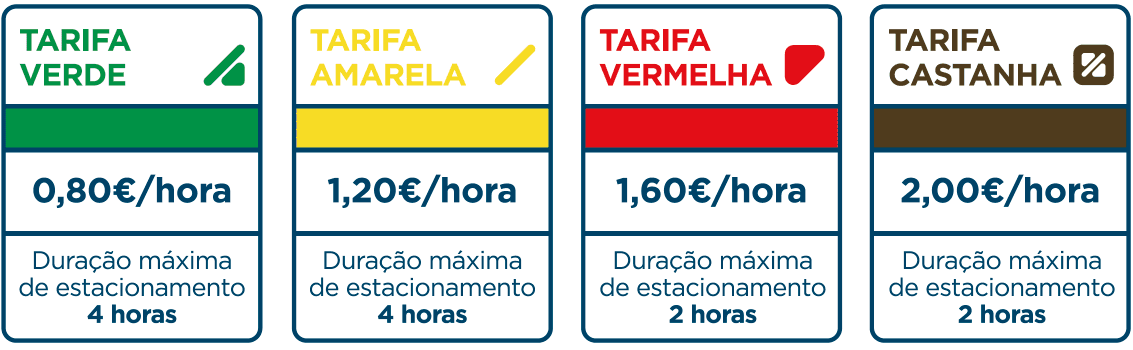
Lisbon currently uses five street-parking tariffs: green, yellow, red, brown and black. Prices increase in areas where demand is higher, while the maximum stay is generally shorter.
Green zones are found in parts of the city with less pressure on parking. They normally allow stays of up to four hours.
Yellow zones also have a maximum stay of up to four hours and are used in areas with greater demand.
Red zones are designed for higher turnover and generally limit parking to two hours.
Brown zones apply in places where demand is particularly high compared with the available spaces. Parking is normally limited to two hours.
Black is the most restrictive tariff and is used in central locations with intense demand. It is not suitable for leaving a car while spending most of the day sightseeing.
Lisbon also has a small number of daily-ticket areas. According to EMEL, these are normally located away from residential streets and close to public transport. Where available, the daily tariff is currently 2€ in green areas and 3€ in yellow areas, generally from Monday to Friday between 9:00 and 19:00. These spaces are specifically identified on local signs. Check the current zone and tariff on the official EMEL parking page.
How to pay for street parking
You can pay at an EMEL parking meter using coins or MB WAY where available. Mobile payment is usually more practical, especially if you do not have Portuguese coins or need to adjust the parking time.
EMEL’s ePark app allows drivers to select the location, parking zone, vehicle registration and intended duration. You can end the session when you return and pay only for the time used, subject to a minimum period of 15 minutes.
Other supported parking apps may also be available. Whichever service you use, check the registration number and zone carefully before confirming. Payment for the wrong vehicle or tariff may still leave you liable for a fine.
An app does not override the maximum stay. If the zone permits only two hours, you cannot legally turn it into all-day parking by extending or restarting the session.
Resident-only parking areas
Some spaces are marked exclusively for residents with a valid parking permit, or dístico de residente. Visitors cannot use these spaces, even if nearby paid parking is full.
Resident restrictions are particularly important in dense residential and historic neighbourhoods. A street may contain general paid spaces during part of the day and become exclusive to residents at night.
EMEL states that a resident permit allows eligible residents to park in properly marked spaces within their home zone and one selected neighbouring zone without paying the regular tariff or observing the standard time limit. However, these benefits apply only to valid permit holders and designated spaces. A resident permit for a second zone is also subject to restrictions in black-tariff areas. See the current conditions on the EMEL resident permit page.
For visitors, the practical rule is simple: never park in a space marked for residents unless your vehicle has the correct permit.
Use a garage for longer stays
A public garage is often the simplest option when you need to leave a car for several hours. You avoid repeatedly checking the meter, searching for another space after the maximum period or misunderstanding a resident restriction.
Garages are particularly useful near Baixa, Chiado, Avenida da Liberdade, Marquês de Pombal and other busy central areas. Check the entrance price list before driving in, as rates and daily maximums vary.
If you are staying at a hotel or apartment, ask about parking before arrival. “Parking available” may refer to a paid public garage nearby rather than a private space at the property. Also check maximum vehicle height if you are driving a van or large SUV.
Leaving luggage visible inside a parked vehicle is not recommended, even in a garage. Take passports, electronics and other valuables with you.
Driving in Lisbon’s historic neighbourhoods
Parking is only one of the difficulties involved in driving through central Lisbon. Alfama, Mouraria, Bairro Alto and parts of Baixa have narrow streets, steep gradients and controlled-access areas.
A navigation app may suggest a route that appears open on the map but is restricted by signs, retractable bollards or local access rules. Follow street signs rather than relying only on the app.
Lisbon also operates a Low Emission Zone, known as the ZER, on weekdays between 7:00 and 21:00. Vehicle requirements depend on the area and emissions standard, with exceptions for certain residents and authorised vehicles. This mainly affects older cars, but anyone driving an older Portuguese or foreign-registered vehicle should check the current Lisbon ZER rules.
If your accommodation is inside a restricted historic area, contact the property before arrival. The host or hotel should explain whether vehicle access is permitted and where you can unload luggage.

Parking at Lisbon Airport
Lisbon Airport has official short- and long-stay parking options. P1 and P2 are among the closest parks to Terminal 1, while other products may offer lower prices for longer stays.
Booking in advance can be useful during busy travel periods and makes it easier to compare options. Use the official ANA airport parking service and confirm the correct terminal, entry time and vehicle registration before paying.
Do not use airport drop-off areas as regular parking. These areas are designed for brief passenger collection or departure, and overstaying may become expensive.
When not to drive in Lisbon
Avoid driving when your day is focused on Baixa, Chiado, Alfama, Bairro Alto or Belém. Public transport and walking are normally easier than moving the car between attractions.
A car is also unnecessary for popular day trips to Sintra and Cascais, both of which have direct train connections from Lisbon. Driving to Sintra can be particularly difficult because of traffic, restricted roads and limited parking near the palaces.
Renting a car becomes more useful when leaving Lisbon for rural areas, smaller towns or a multi-day route through Portugal. In that case, consider collecting it on the morning you leave the city instead of paying to keep it parked throughout your Lisbon stay.
Practical parking tips
Read the nearest street sign every time you park.
Check both the tariff and maximum stay.
Look for resident-only periods, particularly overnight.
Save the vehicle’s location before walking away.
Confirm the registration number when using a parking app.
Use a garage when you need more than two to four hours.
Remove luggage and valuables from view.
Do not drive into a controlled-access street unless you are authorised.
Check parking arrangements with your accommodation before arrival.
FAQs about parking in Lisbon
1. Is street parking free in Lisbon?
Some streets may be free outside regulated hours, but much of central Lisbon uses paid EMEL parking. Always read the local sign because schedules vary by street and zone.
2. What do the parking colours mean in Lisbon?
Green, yellow, red, brown and black identify different EMEL tariffs. Busier areas generally cost more and allow shorter stays, with limits commonly ranging from two to four hours.
3. Can tourists park in resident spaces?
No. Spaces marked for residents require the correct permit. Visitors should use general paid spaces or a public garage.
4. What is the best option for all-day parking?
A public garage is normally easier than street parking. Some EMEL areas offer daily tickets, but these exist only in specific locations identified by signs.
5. Do you need a car in Lisbon?
No. A car is usually inconvenient for central sightseeing. Metro, trams, buses, trains and walking cover most visitor routes, while a rental car becomes more useful after leaving the city.
Continue planning with our guide to How many days in Lisbon? and Is Lisbon walkable? a practical guide for visitors.
Driving into the city? Compare our best hotels in Lisbon with parking.

Rafael Rocha
The Author
Having lived and studied in Lisbon for many years, a deep connection to the city grew naturally over time. Here I share practical guides and local recommendations to help you experience Lisbon better.
Buy me a coffee